Head-Wrist Egocentric Full-Body Pose Recovery System
- Role -
- Summer Researcher, HKU MMLab
- Date -
- March 1, 2026
- Stack —
- Kalibr, RTMPose, Fisheye Camera, Multi-view Triangulation, PyTorch, SolidWorks
An end-to-end platform for synchronized wearable capture, multi-view ground-truth reconstruction, and egocentric pose learning.
Overview
I built an end-to-end research platform for egocentric full-body pose recovery, spanning wearable hardware, synchronized multi-camera capture, external 3D human reconstruction, fisheye projection and optimization, and model training based on EgoRear and EgoPoseFormer.
End-to-end pipeline
- Design and calibrate the headband and wristband capture hardware.
- Record synchronized six- and nine-camera fisheye video together with head and wrist IMU streams.
- Recover high-quality external 2D and 3D human pose as ground truth from multi-view observations.
- Transform and project the reconstructed pose into the head-mounted fisheye camera coordinate system.
- Process aligned real-world sequences and train egocentric pose models in the EgoRear and EgoPoseFormer frameworks.
Mechanical design
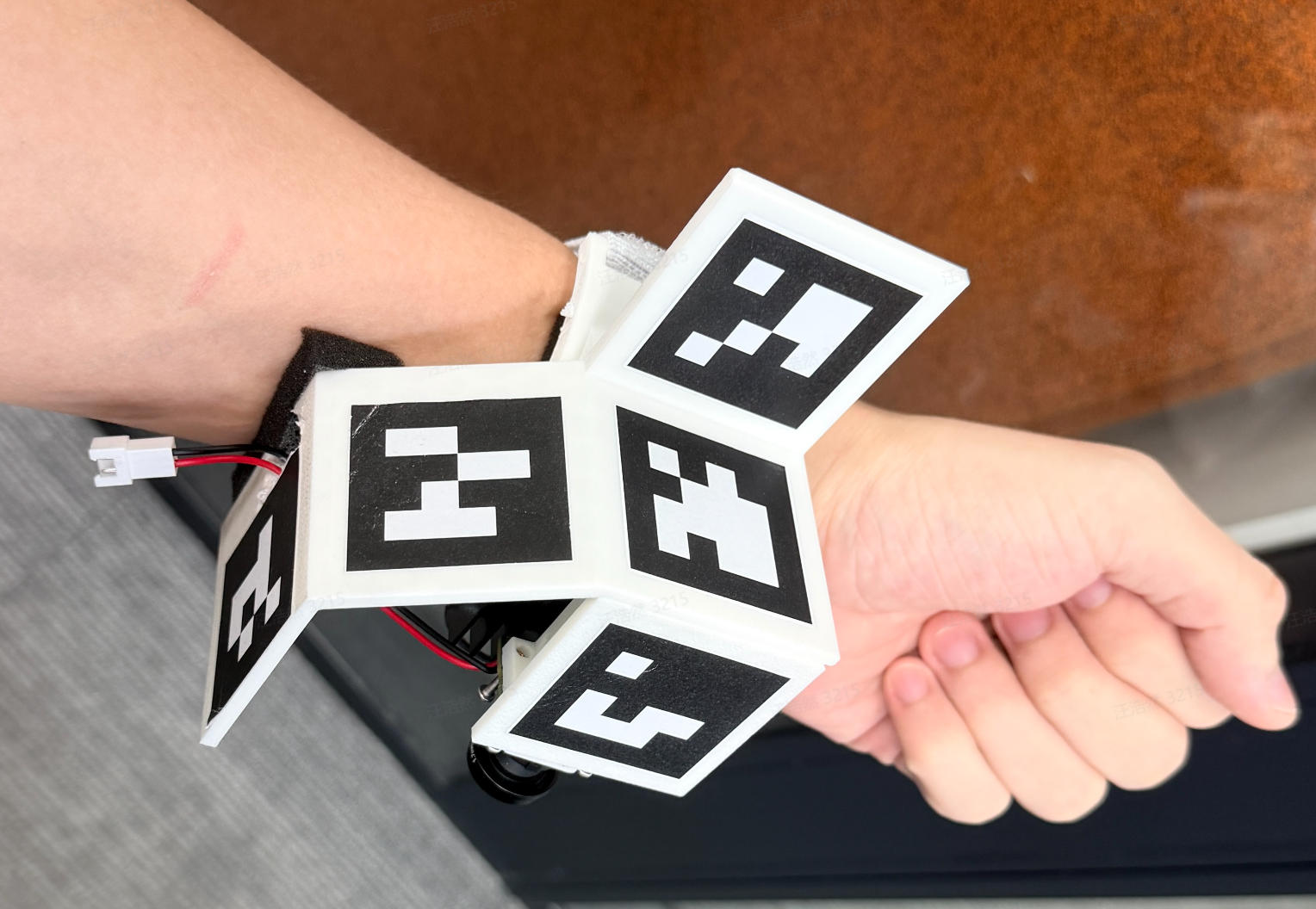
I iterated the headband and wristband through hardware generations. The mechanical interfaces constrain each camera, fiducial tag, and motion-capture rigid body in a stable geometric chain, making the wearable setup repeatable across calibration and recording sessions.
My contribution
- Designed the mechanical wearable system and assembled the camera, trigger, tag, rigid-body, and IMU electronics.
- Iterated the headband and wristband through six hardware generations, making the camera-tag-rigid-body geometry repeatable and calibratable.
- Built the synchronized video and inertial capture stack, including external triggering, timestamp alignment, H.265 recording, and Kalibr intrinsic and extrinsic calibration with the omni fisheye model.
- Developed the multi-view ground-truth reconstruction pipeline and the projection from the external reference frame to each head-mounted camera.
- Collected, processed, and validated multiple real-world batches for model training and evaluation.
- Refactored the research code into a reproducible project and prepared the public GitHub repository.
System design and synchronized capture
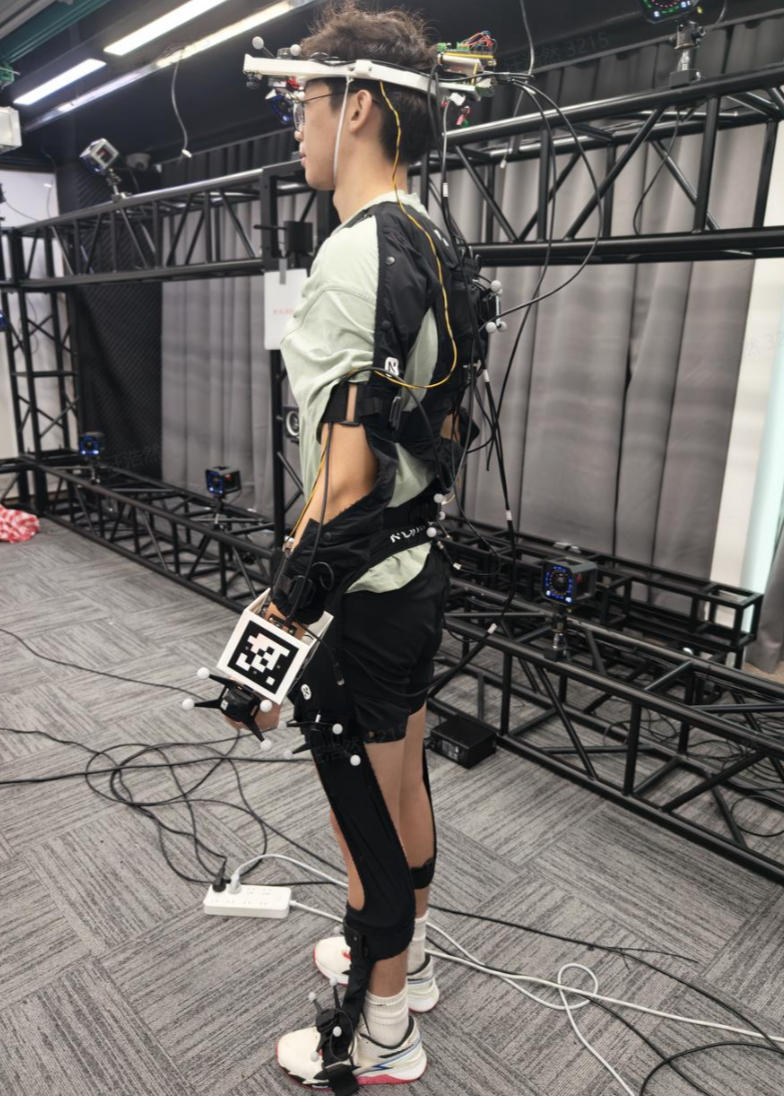
The acquisition system combines DepthAI/OAK cameras with head and wrist IMUs. An external trigger starts all streams from a shared event, while per-frame timestamps support fine-grained temporal alignment across six- and nine-camera configurations. Camera intrinsics and inter-camera extrinsics are calibrated in Kalibr using an omni-directional fisheye model.
The wearable hardware was designed around a stable geometric chain between each camera, fiducial tag, and motion-capture rigid body. This makes calibration repeatable across recording sessions and allows the complete capture rig to be reconstructed in a common coordinate system.
3D pose ground truth
External stereo and multi-view cameras run RTMPose/RTMW for 2D keypoint detection. Each keypoint is reconstructed through fisheye multi-ray triangulation, then transformed through the optical motion-capture rigid-body chain. The resulting 3D skeleton is projected into the head-mounted fisheye cameras to produce aligned 2D and 3D pose ground truth for egocentric learning.
This process connects external observations with the moving wearable coordinate frame, providing cleaner supervision than relying on a single reconstruction or projection stage.
Egocentric hand pose exploration
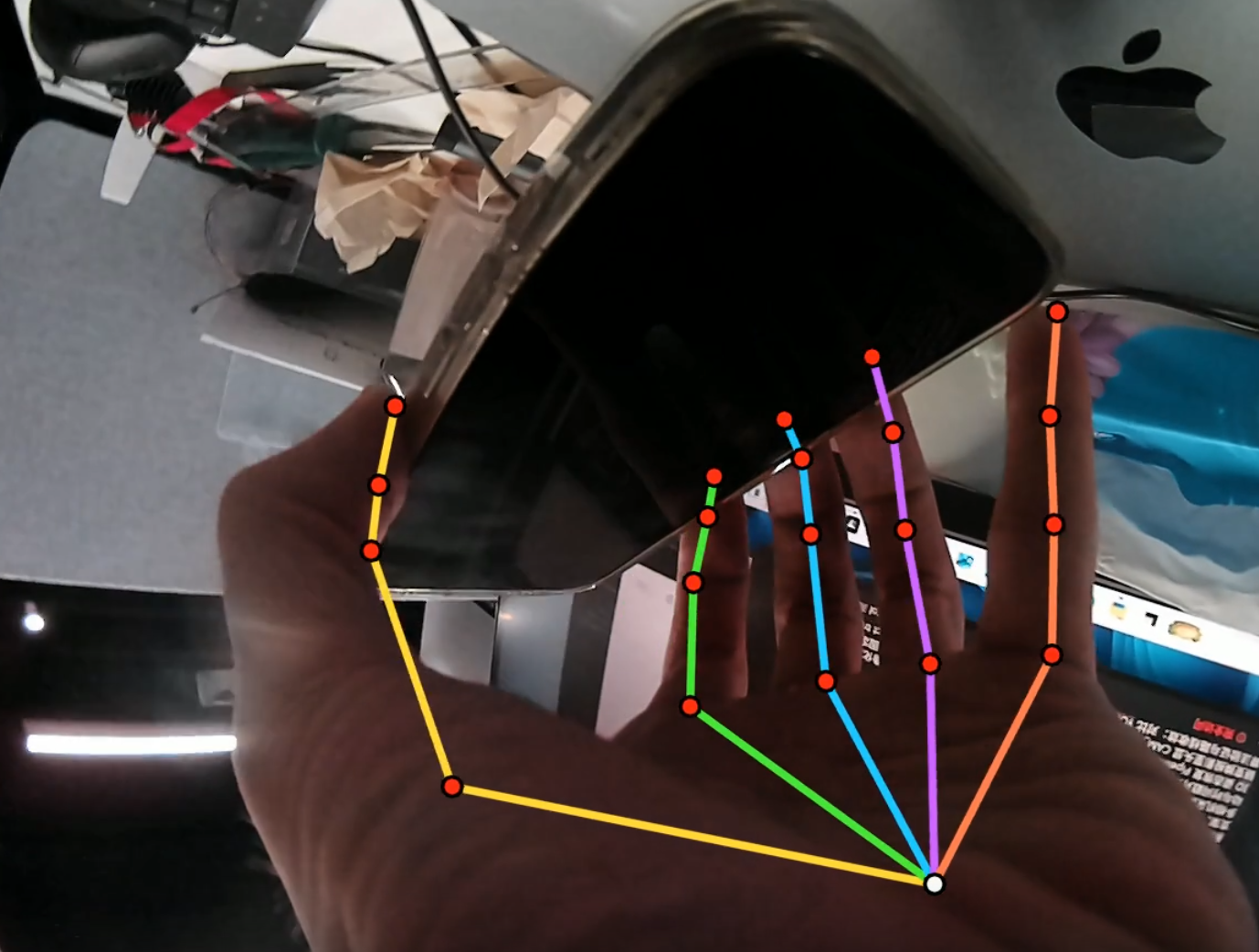
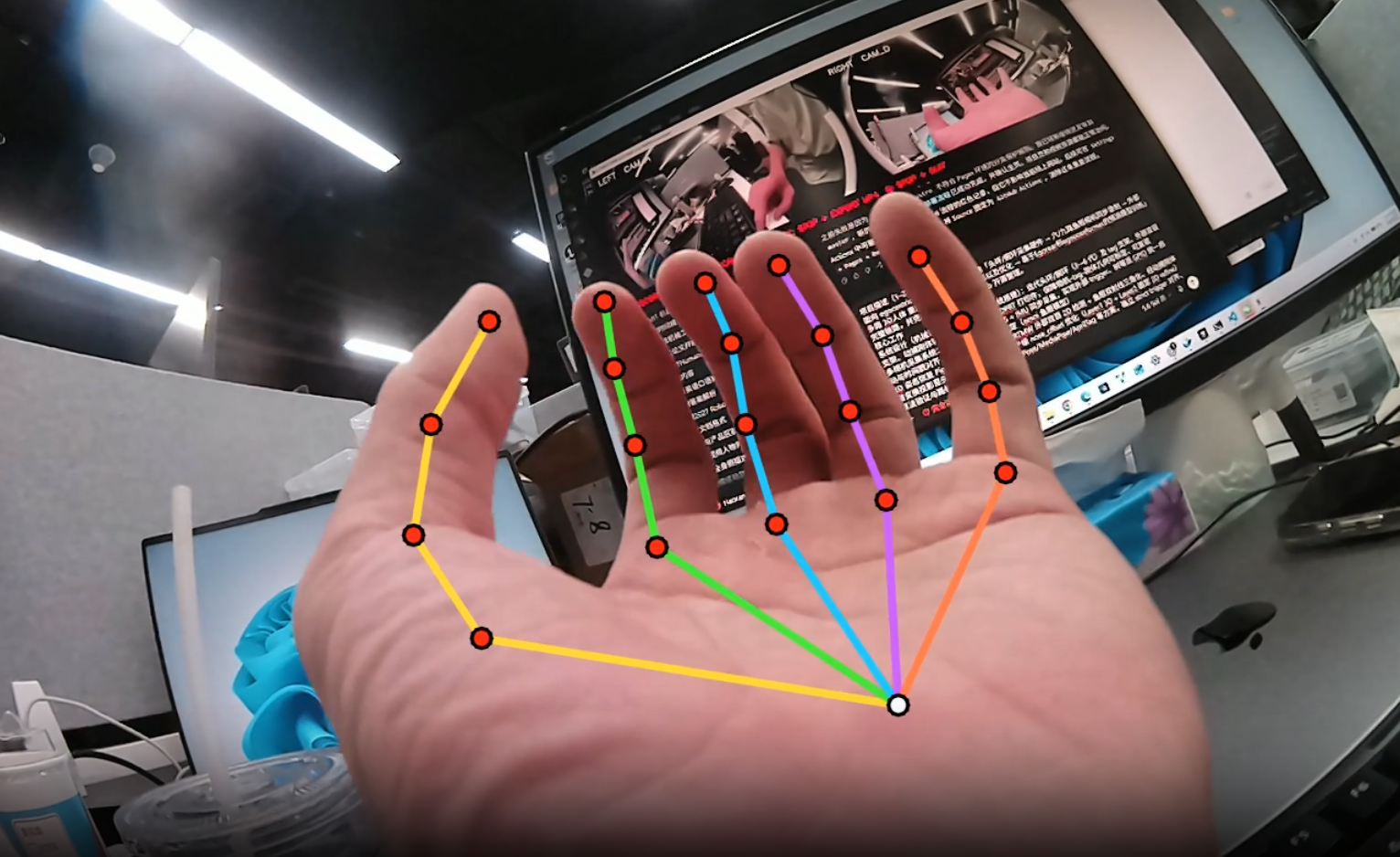
I explored hand-pose perception from both inward-facing wrist cameras and head-mounted stereo views during object manipulation. These experiments tested whether compact egocentric cameras could recover stable 2D hand skeletons despite close-range distortion, self-occlusion, and rapid viewpoint changes.
Real-world data and model training
Across multiple capture batches, I collected approximately two hours of synchronized and aligned real-world data. I built the batch-processing workflow used to generate training-ready sequences, then ran multiple rounds of staged training and evaluation within the EgoRear framework while adapting components from EgoPoseFormer.
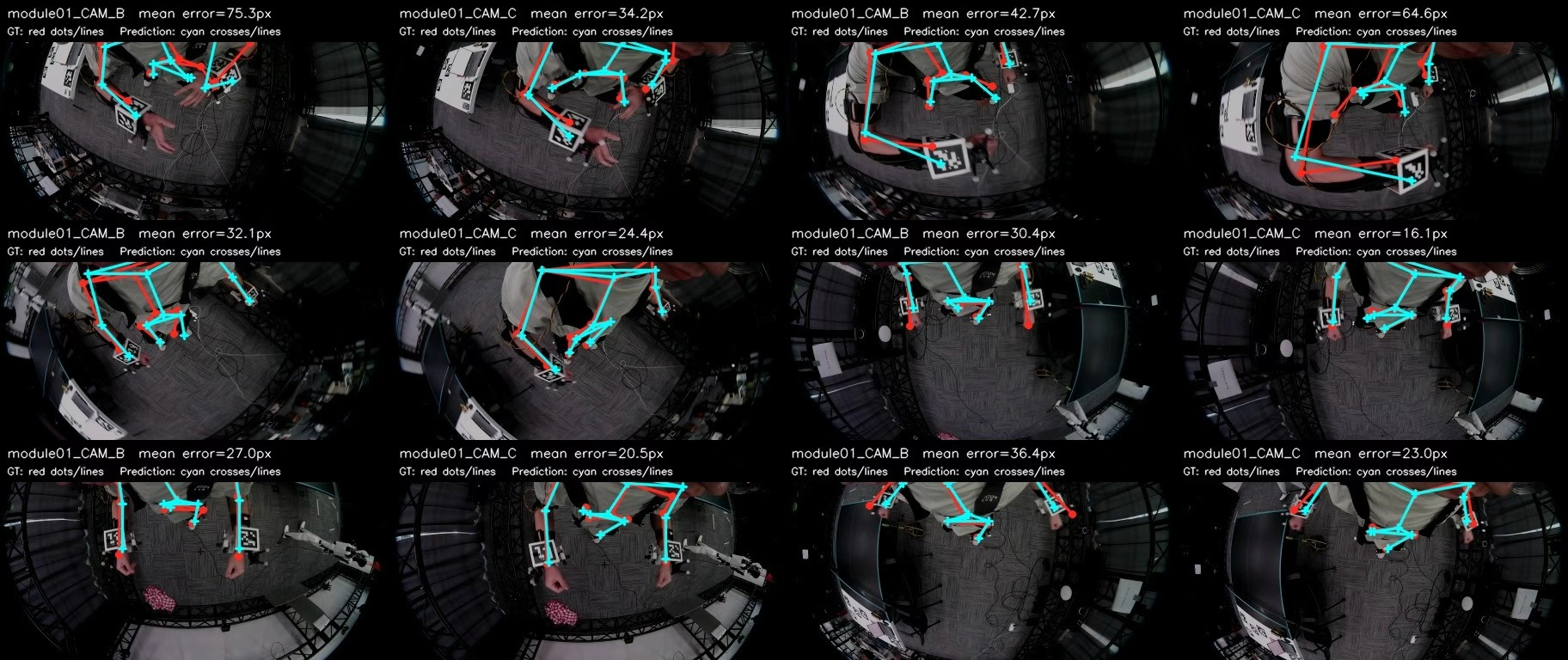
3D Pose Estimation
| Method | Dataset and camera setup | MPJPE ↓ |
|---|---|---|
| Our method | Internally collected data, validation split | 50.5 mm |
| EgoPoseFormer | SceneEgo, real-world monocular | 93.0 mm |
| EgoPoseFormer | Ego4View-RW, two front cameras | 77.95 mm |
| EgoPoseFormer | Ego4View-RW, two front and two rear cameras | 63.38 mm |
| EgoRear | Ego4View-RW, two front and two rear cameras | 56.94 mm |
| EgoPoseFormer | UnrealEgo, synthetic stereo | 33.4 mm |
Published results are included as literature references; datasets, camera configurations, skeleton definitions, and evaluation protocols differ.
Simulation and supporting tools
In parallel, I developed a simulation and validation environment using Isaac Sim and BlenderProc. The tooling compares Mahony-filtered head and wrist IMU orientation against optical motion capture, provides skeleton playback for debugging, and generates randomized synthetic motion from AMASS sequences and SMPL-X bodies.
This environment supported geometry studies before hardware experiments and supplied large-scale pretraining data and simulation validation tools to a parallel project team.
Technology
Kalibr, RTMPose, fisheye cameras calibration, multi-view triangulation, PyTorch, Isaac Sim, BlenderProc, SolidWorks, ArUco/AprilTag, SMPL-X.